February 05
The role of modular steel bridging in planning for increasing climate disasters
Since at least 1850, when data began to be recorded, the temperature of our planet has been rising. For many years, the decade-over-decade increase was consistent, but since 1982, the rate of warming has accelerated significantly. According to the National Oceanic and Atmospheric Administration’s (NOAA) Annual Global Climate Report, 2024 was the warmest year on record, and the 10 warmest years since 1850 were from 2015-2024.
For some time, scientific studies have closely associated rising temperatures with widespread changes in weather patterns, including an increase in the frequency and intensity of extreme weather events. These predictions have been borne out, with NOAA’s National Centers for Environmental Information noting that in the U.S. in 2024, there were 27 confirmed weather/climate disaster events with losses exceeding $1B each and putting the year in second place, trailing only the 28 events of 2023, in an annual tally that began in 1980. To put 2024 in perspective, the average number of annual events during the first decade of the report was 3.3 per year, with increases each decade. In the last three years of complete reporting (2022-2024), the annual number of events had risen to 24.3 per year – a 730% increase. And because these numbers include only the costliest events (CPI adjusted), it is a conservative estimate of how much extreme weather costs the U.S. each year. The steep human toll of these events is rising as well, with fatalities nearly doubling over the 44 years of reporting.
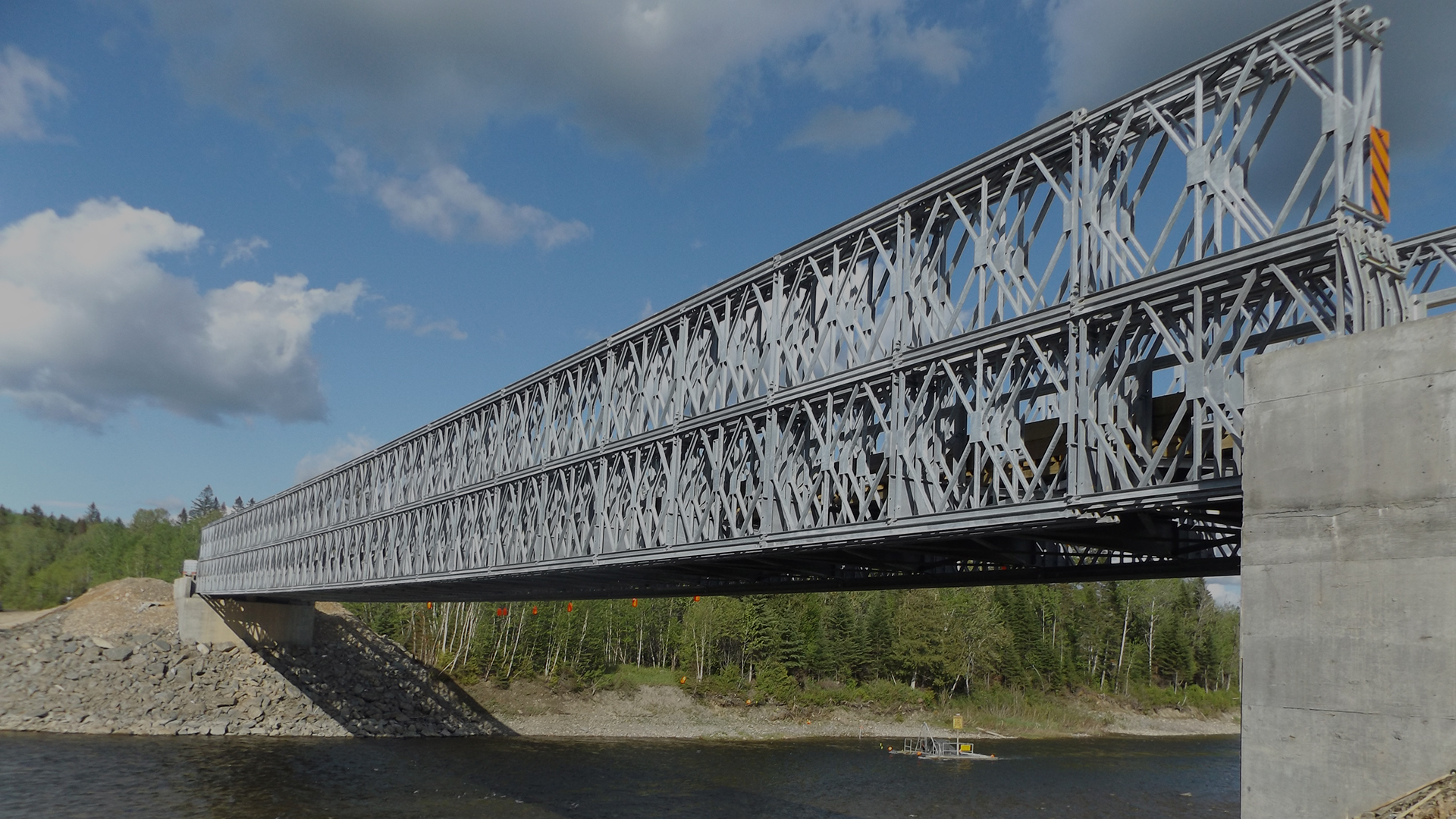
In recent years, to address the increasing risk of these disasters, there has been a greater focus on the importance of comprehensive resilience planning for transportation infrastructure. Because they are so exceptionally climate resilient, modular steel bridges are an excellent choice for proactive planning against future climate events. They deliver enhanced structural robustness and can be designed to accommodate high wind loads, high water pressure loads, and seismic requirements. Modular structures are easily inspected, and should damage occur, they can be rapidly repaired — using standard, interchangeable components — or replaced much more quickly than more traditional concrete structures. In the case of clear-span bridging, having no intermediate piers means less potential for damage from floating debris during storms.
While a robust framework that anticipates climate hazards includes many components, it is critical such plans include strategies and solutions to expedite recovery in the event routes are damaged or destroyed.
As these extreme weather events have become more common, we have seen an increase in the number of emergency projects for customers all over the world who turn to modular steel bridging as the solution of choice for recovering effectively after a disaster. Rapidly installed, safe, robust and reliable, modular steel bridging is often chosen over traditional construction methods for these applications. Components can be easily shipped to any location worldwide, including remote and challenging sites, and structures are quickly assembled with only minimal equipment requirements. Precision-engineered to ensure trouble-free installation, high-quality modular steel bridges can be deployed, dismantled and re-deployed in a wide range of configurations to deliver outstanding versatility.
Because the speed of reconstruction is critical after an emergency, Acrow holds a significant supply of bridging components in stock in strategic locations across the globe, ready for immediate deployment to customers. Likewise, owing to the importance of having plans and equipment in place to restore transportation lifelines quickly, a growing number of local and national governments – as well as international humanitarian aid agencies – maintain inventories of modular bridging for emergency use as needed. This has proved to be invaluable in the case of natural disasters, enabling rapid response within days to affected areas.
In the U.S., the states that have the most significant backup bridge assets are those most prone to hurricanes. With several kilometers of modular bridging and assembling equipment warehoused across the state, the Florida Department of Transportation uses this inventory for both emergency use and planned projects. After Hurricane Helene left parts of North Carolina and Tennessee devastated in the fall of 2024, the governor of Florida, which was less impacted by the storm, launched Operation Blue Ridge to provide recovery assistance to the two neighboring states. The multi-agency response included bridge inspection teams along with 7,500 feet (2.3 km) of modular bridging. As was noted in the announcement for the operation, “Florida’s strong disaster preparation and efficient response efforts have made it possible to provide much-needed assistance to other states.”
The ever-present, increasing risk of extreme climate events underscores the need for comprehensive resilience planning to help safeguard communities and the transportation infrastructure they rely on. When the need to reconnect damaged or destroyed infrastructure is critical, we believe versatile, high-quality modular bridging can offer an extremely effective solution to accelerating bridge construction during post-emergency response and recovery operations.